
AI Translation: Threat or Opportunity?
Artificial intelligence is no longer a distant concept for the language industry — it is already reshaping how businesses, NGOs, and international organizations communicate across borders. AI translation tools are faster, cheaper, and more accessible than ever, and they are transforming an entire profession in the process.
One question we always get from language professionals, clients, and businesses that rely on multilingual communication is: Is AI translation a threat to human translators, or is it the greatest opportunity the industry has ever seen?
The honest answer is nuanced — and understanding where AI translation genuinely excels, and where it still falls short, is the key to using it wisely.
🚀 What Is AI Translation and How Far Has It Come?
AI translation refers to the use of machine learning systems — most commonly Neural Machine Translation (NMT) — to automatically convert text or speech from one language into another. Tools like Google Translate, DeepL, and Microsoft Translator have improved dramatically in accuracy, fluency, and speed over the past decade, and AI translation is now embedded in everything from customer service chatbots to enterprise content workflows.
A 2021 study published in the journal PLOS ONE found that for certain language pairs and content types — particularly high-resource languages like English, French, and Spanish — neural machine translation achieved near-human quality scores in readability and adequacy (Bentivogli et al., 2021). For straightforward, repetitive, or highly structured content such as technical manuals, product descriptions, and internal communications, AI translation can deliver fast and cost-effective results.
The growth of the AI translation market reflects this momentum:
The global machine translation market was valued at $983 million in 2023 and is projected to reach $4.3 billion by 2032 (Precedence Research, 2023)
Companies like Amazon and Facebook process billions of words per day using AI translation systems
Translation memory and AI-assisted tools have increased translator productivity by an estimated 30 to 50 percent (SDL/RWS Industry Report, 2022)
For businesses managing large volumes of content under tight deadlines, AI translation tools have become impossible to ignore.
The technology behind these tools traces back to a single 2017 study, which we explore in our article on the translation study behind today's AI boom.
✅ Where AI Translation Excels
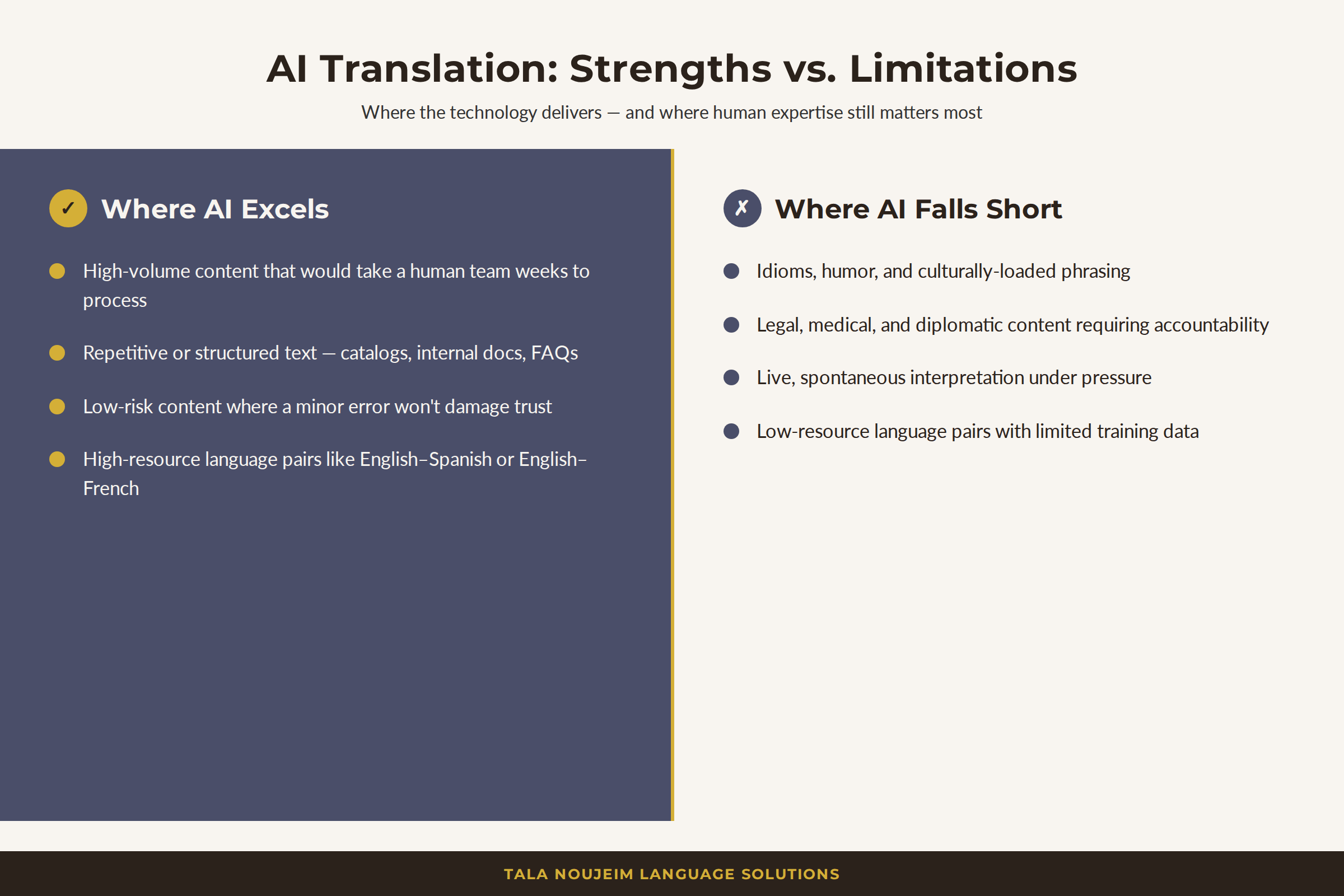
AI translation is at its strongest when content is:
High-volume — large batches of text that would take a human team weeks to process manually
Repetitive or structured — product catalogs, internal documentation, FAQs
Low-risk — content where a minor error won't damage trust, safety, or legal standing
In high-resource language pairs — languages with large amounts of training data available, like English-Spanish or English-French
In these scenarios, AI translation offers real, measurable advantages in speed and cost — advantages that no human team can match at the same scale.
⚠️ Where AI Translation Falls Short
Despite its impressive capabilities, AI translation has well-documented limitations, and they matter enormously depending on the context.
💬1. Language Is More Than Words
Human language is deeply embedded in culture, history, emotion, and context. Idioms, humor, metaphor, and tone are notoriously difficult for AI translation systems to handle accurately. A phrase that works perfectly in English may carry entirely different connotations when translated literally into Arabic or Japanese.
A frequently cited example is the automatic mistranslation of the Ukrainian city name "Velyka Novosilka" by Google Translate into Russian in 2022, which produced an offensive and politically charged result — a stark reminder that AI translation can miss meaning that goes beyond the literal text (The Guardian, 2022).
⚖️2. High-Stakes Content Requires Human Judgment
Legal contracts, medical documents, diplomatic communications, and sworn testimonies require precision, accountability, and professional responsibility. A mistranslation in a court document or a clinical trial report can have serious — even life-threatening — consequences.
The American Translators Association (ATA) consistently emphasizes that certified human translators remain the standard for legal, medical, and official documentation, precisely because accountability cannot be automated.
✍️AI Translation and Arabic: Where the Technology Still Struggles
Everything above is general industry context. But I want to add something more specific, drawn from my own experience running a language business day to day: AI translation into Arabic is, in my experience, one of the weakest applications of the technology today.
Over the years, I have repeatedly tested and worked with AI translation tools — including Google Translate and Tarjama — specifically to see whether they could reliably handle Arabic content for my clients. I was almost never satisfied with the result.
Arabic is a structurally and semantically complex language. It carries heavy inflection, context-dependent word order, and layers of meaning that shift depending on register, dialect, and audience. The learning models behind today's AI translation tools have not yet been able to fully integrate that underlying logic. Nuances that a model can grasp reasonably well in English, French, or Spanish are frequently lost, flattened, or simply misread when the target language is Arabic.
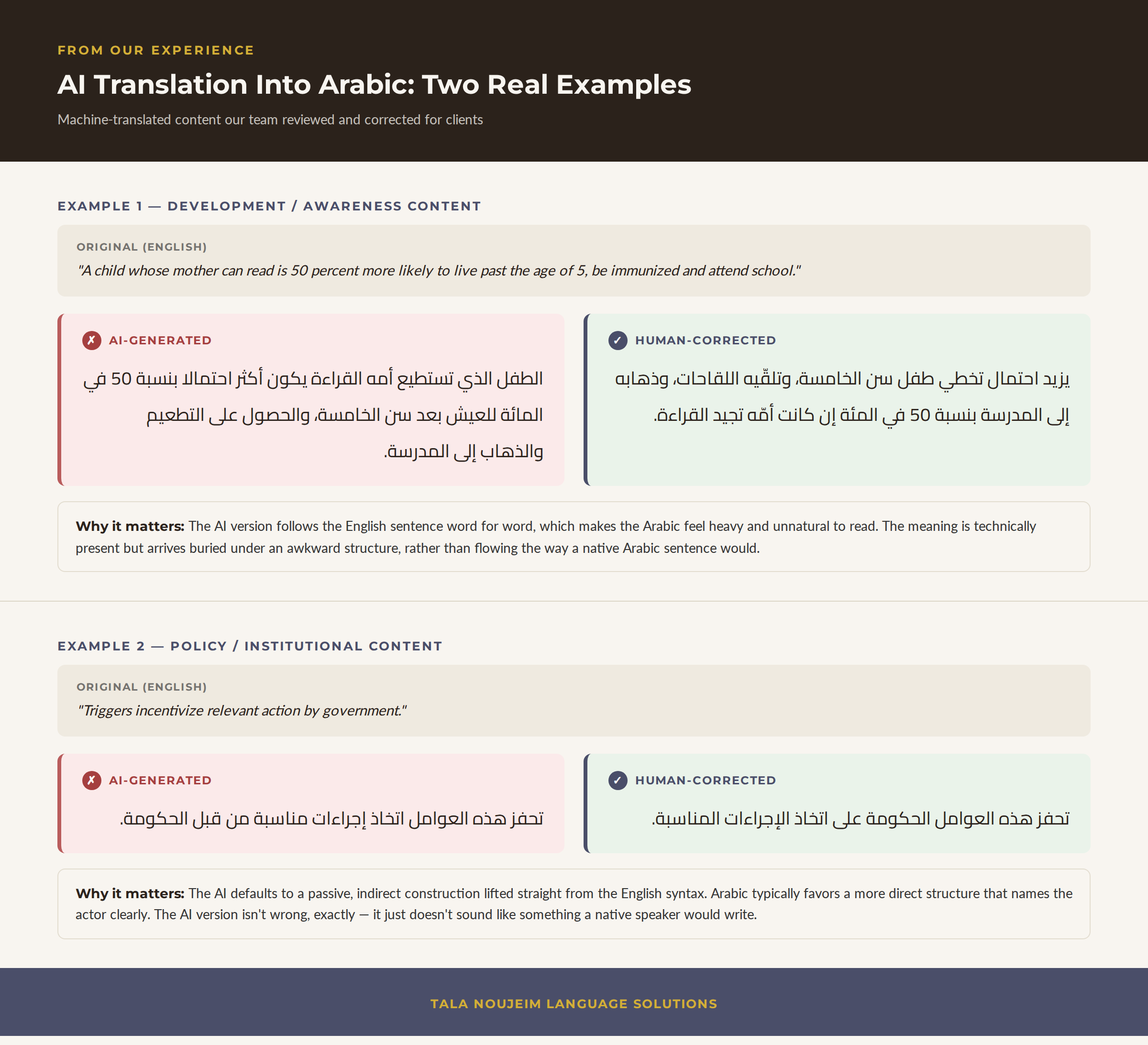
This is not a theoretical concern. It shows up constantly in my own proofreading work. Here are two real examples pulled directly from AI-translated content I was asked to review:
Example 1 — Development and awareness content
Original: "A child whose mother can read is 50 percent more likely to live past the age of 5, be immunized and attend school."
The AI-generated version followed the English sentence structure almost word for word. The result was technically comprehensible, but heavy and unnatural to read — the kind of sentence a native Arabic reader has to work to get through, rather than one that flows the way Arabic actually moves. My correction restructured the sentence around how Arabic naturally builds meaning, rather than mapping the English clause by clause.
Example 2 — Policy and institutional content
Original: "Triggers incentivize relevant action by government."
Here, the AI defaulted to a passive, indirect construction lifted directly from the English syntax. Arabic typically favors a more direct structure that names the actor clearly. The AI output wasn't factually wrong — every word was accurate — but it simply didn't read like something a native speaker would write.
In both cases, the issue was rarely vocabulary. The AI systems could almost always find a correct word for a correct word. What they consistently failed to do was understand context — what was implied rather than stated, what tone a sentence needed to carry, or how a phrase would actually land with an Arabic-speaking reader rather than simply read as grammatically valid.
In my experience, machine translation into Arabic works reliably in one specific case: purely technical documents, written in short, direct sentences, with no context or subtext to interpret. A parts list, a set of instructions, a straightforward data table — content where every sentence means exactly and only what it says — is where AI translation into Arabic can be trusted with minimal intervention. The moment a document requires reading between the lines, which is most of what my clients actually send me, the technology reaches its limit.
This is precisely why, at Tala Noujeim Language Solutions, every Arabic translation — AI-assisted or not — passes through human review before it reaches a client.
🎙️Can AI Translation Handle Live Interpretation?
For a long time, live interpretation was considered largely untouchable by AI translation technology. The cognitive complexity involved — processing speech in real time, managing cultural nuance, and delivering accurate output under pressure — seemed far beyond what any machine could replicate.
That is beginning to change. AI-powered interpretation platforms are already on the market and gaining traction. KUDO, for example, integrates AI-assisted interpretation features into its remote simultaneous interpretation platform, enabling hybrid human-AI workflows. Other platforms such as Interprefy and WordLink are also exploring AI-assisted interpretation, signaling that the technology is advancing faster than many anticipated.
However, industry experts and research consistently highlight that AI interpretation still struggles significantly with:
Spontaneous, unscripted speech and natural conversational patterns
Emotional register and tone — critical in diplomatic, legal, and humanitarian settings
Low-resource language pairs where training data is limited
High-stakes environments such as courtrooms, medical consultations, and international negotiations, where errors carry serious consequences
The consensus among interpretation professionals and organizations such as AIIC is that while AI tools may increasingly support human interpreters, they are not yet — and may not be for some time — a replacement for trained professionals in complex, live settings.
For organizers running online or hybrid events, we have also outlined the remote interpretation pitfalls to plan for.
🤝The Rise of Human-AI Translation Partnerships
Rather than replacing human translators, the most forward-thinking language professionals are embracing a hybrid model — one where AI translation handles volume and speed while humans provide quality, judgment, and cultural intelligence.
This model, often called Machine Translation Post-Editing (MTPE), involves a human translator reviewing and refining AI-generated output. It combines the efficiency of AI translation with the irreplaceable value of human expertise.
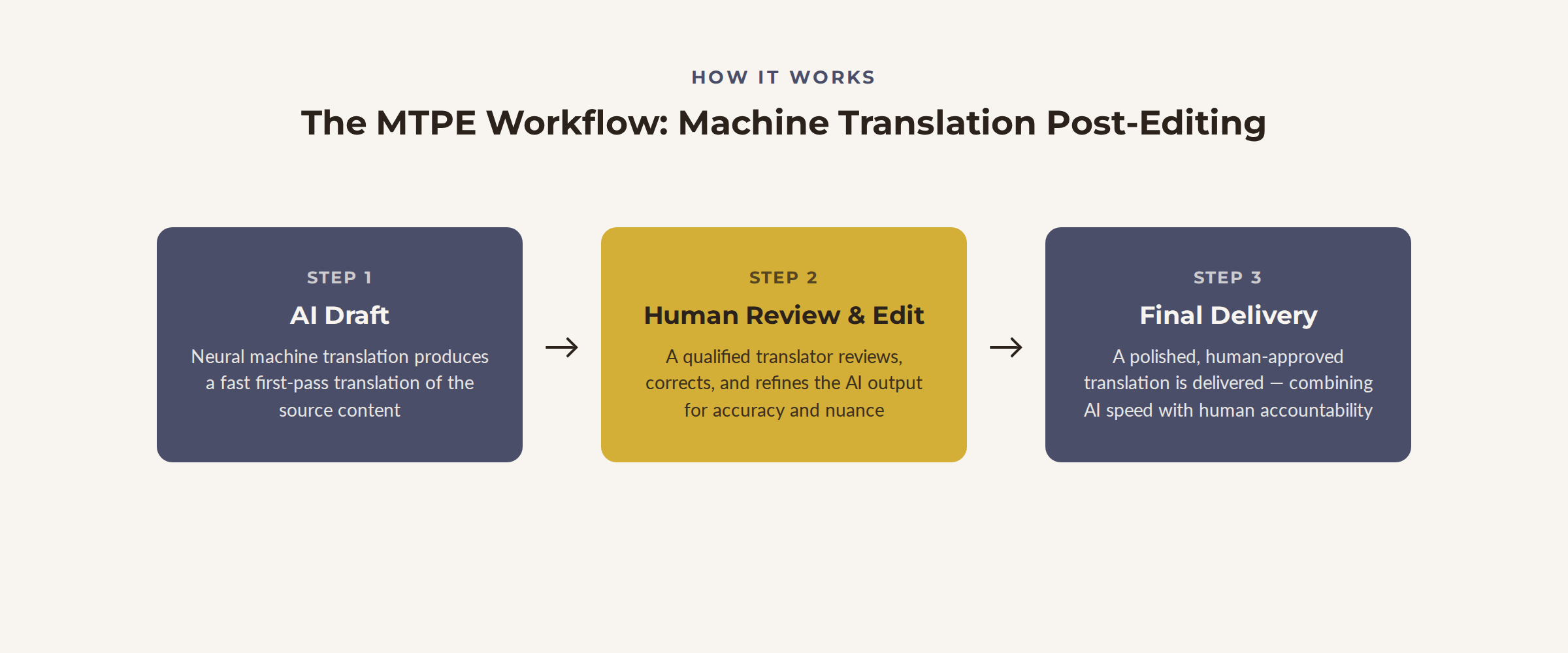
According to a 2022 survey by the Globalization and Localization Association (GALA), 72 percent of language service providers now offer MTPE as part of their service portfolio — a clear indicator that the industry is adapting to AI translation rather than resisting it.
The translators and interpreters thriving in this new landscape are those who have:
● Developed specialization in high-value fields such as legal, medical, or technical translation
● Embraced AI literacy and learned to work with, rather than against, new tools
● Doubled down on cultural competence — the one area where human professionals remain unmatched
📋What AI Translation Means for You as a Client
If you are an event organizer, NGO manager, or business leader who relies on language services, here is what the rise of AI translation means for you in practical terms:
Faster turnaround times for large-volume content using AI-assisted workflows
Lower costs for content types where MTPE is appropriate
No compromise on quality for high-stakes communications, where human expertise remains essential
Greater transparency from language service providers who understand both the possibilities and the limitations of AI translation
The key is working with a language partner who can guide you toward the right solution for each specific need, rather than applying a one-size-fits-all approach to AI translation.
❓Frequently Asked Questions About AI Translation
Is AI translation as accurate as human translation?
For high-resource language pairs and simple, repetitive content, AI translation can approach human-level accuracy. For nuanced, culturally sensitive, or high-stakes content, human review remains essential.
Will AI translation replace human translators?
Most industry evidence points toward a hybrid future rather than full replacement, with AI handling volume and speed while human experts provide judgment, accountability, and cultural accuracy.
What is MTPE?
Machine Translation Post-Editing (MTPE) is a workflow where a human translator reviews and refines AI-generated translation output, combining automation speed with human quality control.
🔑 The Verdict: AI Translation Is an Opportunity — With Conditions
AI translation is not the end of the translation profession. It is the beginning of a new chapter — one that demands greater specialization, adaptability, and human-AI collaboration.
The threat is real for those who resist change. But for language professionals and clients who embrace AI translation with knowledge and strategy, it represents one of the greatest opportunities the industry has ever seen.
The question is not whether AI translation will change the industry. It already has. The question is whether you are ready to navigate that change wisely.
At Tala Noujeim Language Solutions, we combine human expertise with the latest AI translation technology to deliver quality, efficiency, and peace of mind — for every project, in every language. Get in touch to discuss your next translation or interpretation project.
References
● Bentivogli, L., et al. (2021). Neural Machine Translation: A Systematic Review. PLOS ONE.
● Precedence Research. (2023). Machine Translation Market Size and Forecast 2023–2032.
● SDL/RWS Industry Report. (2022). Translation Technology and Productivity Benchmarks.
● The Guardian. (2022). Google Translate's Mistranslation of Ukrainian City Names.
● AIIC. (2023). Artificial Intelligence and Conference Interpretation: Current State and Future Outlook.
● GALA. (2022). Language Industry Survey: Trends and Developments.
● American Translators Association. (2023). Standards for Legal and Medical Translation.
