
Attention Is All You Need: The Paper Behind the AI Boom

"Attention Is All You Need" is a 2017 research paper by eight Google researchers that introduced the Transformer, the architecture behind ChatGPT, Gemini, Claude, DeepL and today's Google Translate. Its main breakthrough was letting a machine read every word of a sentence at once and weigh how each word relates to the others, which made machine translation more accurate and AI far faster and cheaper to train. It matters to anyone who commissions or delivers translation because the technology now reshaping the language industry was first built, and tested, as a translation system.
Professor Ziad Francis made this point at a roundtable organized by the École de traducteurs et d'interprètes de Beyrouth (ETIB) at Université Saint-Joseph (USJ) on the occasion of International Translation Day. This article explains what the study proposed, why it changed artificial intelligence so profoundly, and what its legacy means for translators, interpreters, and the organizations that rely on them.
🚀 What Is "Attention Is All You Need"?
"Attention Is All You Need" is a research paper written by eight researchers at Google Brain and Google Research: Ashish Vaswani, Noam Shazeer, Niki Parmar, Jakob Uszkoreit, Llion Jones, Aidan N. Gomez, Łukasz Kaiser and Illia Polosukhin. The paper notes that all eight contributed equally, and their names are listed in random order.
The study was first posted online on 12 June 2017 and formally presented in December 2017 at NeurIPS, the leading annual conference on machine learning. Its title is a playful nod to the Beatles song "All You Need Is Love." The name "Transformer" was chosen by Jakob Uszkoreit, reportedly because he liked the sound of the word.
Almost a decade later, the paper has been cited more than 250,000 times, and a 2025 analysis by the journal Nature ranked it seventh among the most-cited scientific papers of the twenty-first century.
💬 A Study Born From Translation
Before 2017, the best machine translation systems relied on "recurrent" neural networks. These systems read a sentence one word at a time, from left to right, carrying a compressed memory of everything read so far. The approach worked, but it had two serious weaknesses: it was slow, because each word had to wait for the previous one, and it tended to lose track of context in long sentences.
In 2014, researchers Dzmitry Bahdanau, Kyunghyun Cho and Yoshua Bengio had already introduced a helpful addition called "attention," again for translation. Attention allowed the system, while producing each word of the target sentence, to look back at the most relevant words of the source sentence. It was, in effect, a way of teaching a machine to glance back at the original text, much as a translator does.
The Google team asked a bold question: what if attention was not an add-on, but the entire system? They removed the word-by-word reading altogether and built a model in which every word looks at every other word in the sentence at once. The paper's title states their conclusion.
To prove the idea, they tested the Transformer on two standard translation benchmarks:
English to German (WMT 2014): 28.4 BLEU, surpassing all previous results, including ensembles of several models.
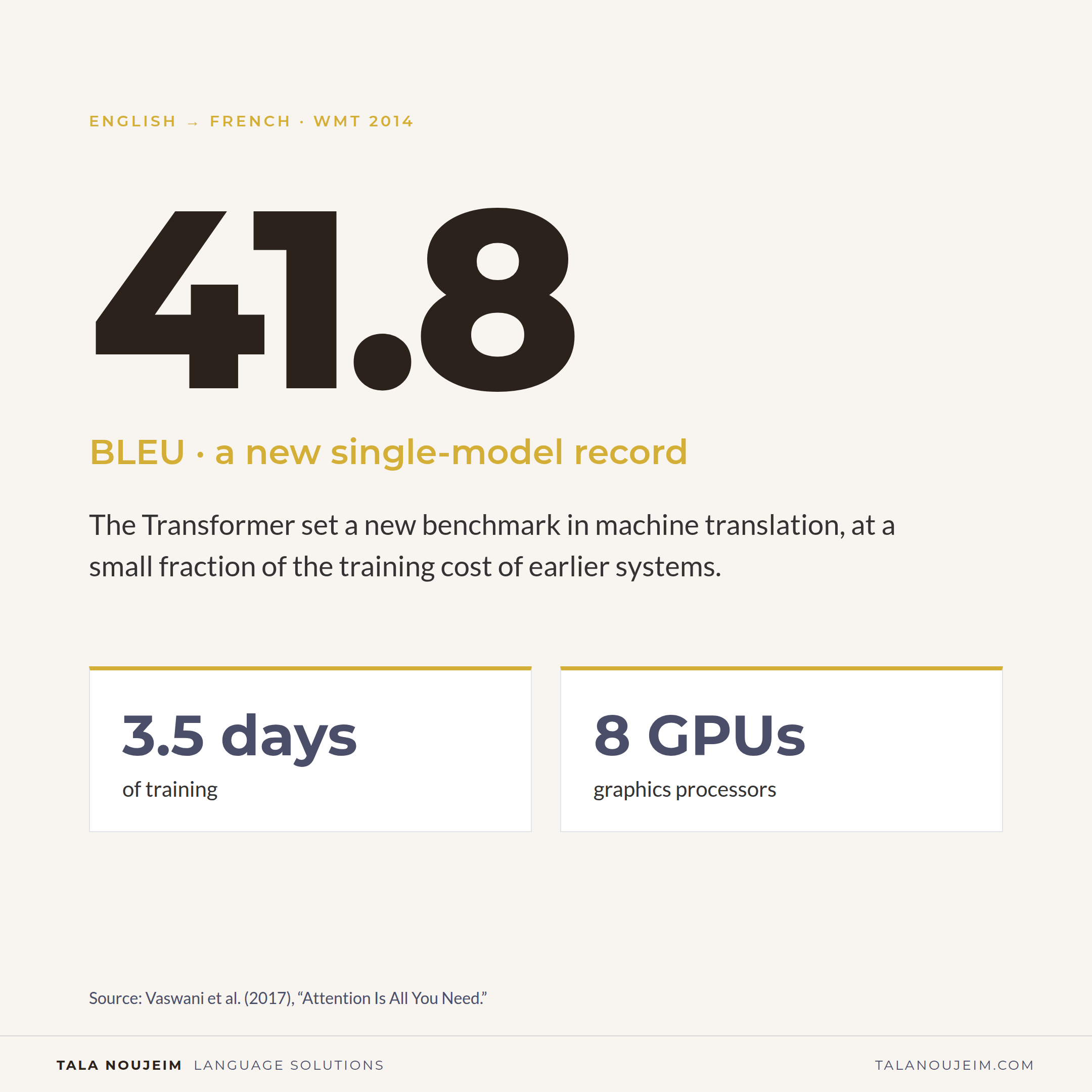
English to French (WMT 2014): 41.8 BLEU, a new record for a single model, reached after only 3.5 days of training on eight graphics processors.
BLEU is an automatic score that measures how closely a machine translation overlaps with human reference translations. The Transformer was not only more accurate; it was dramatically cheaper and faster to train than the systems it replaced.
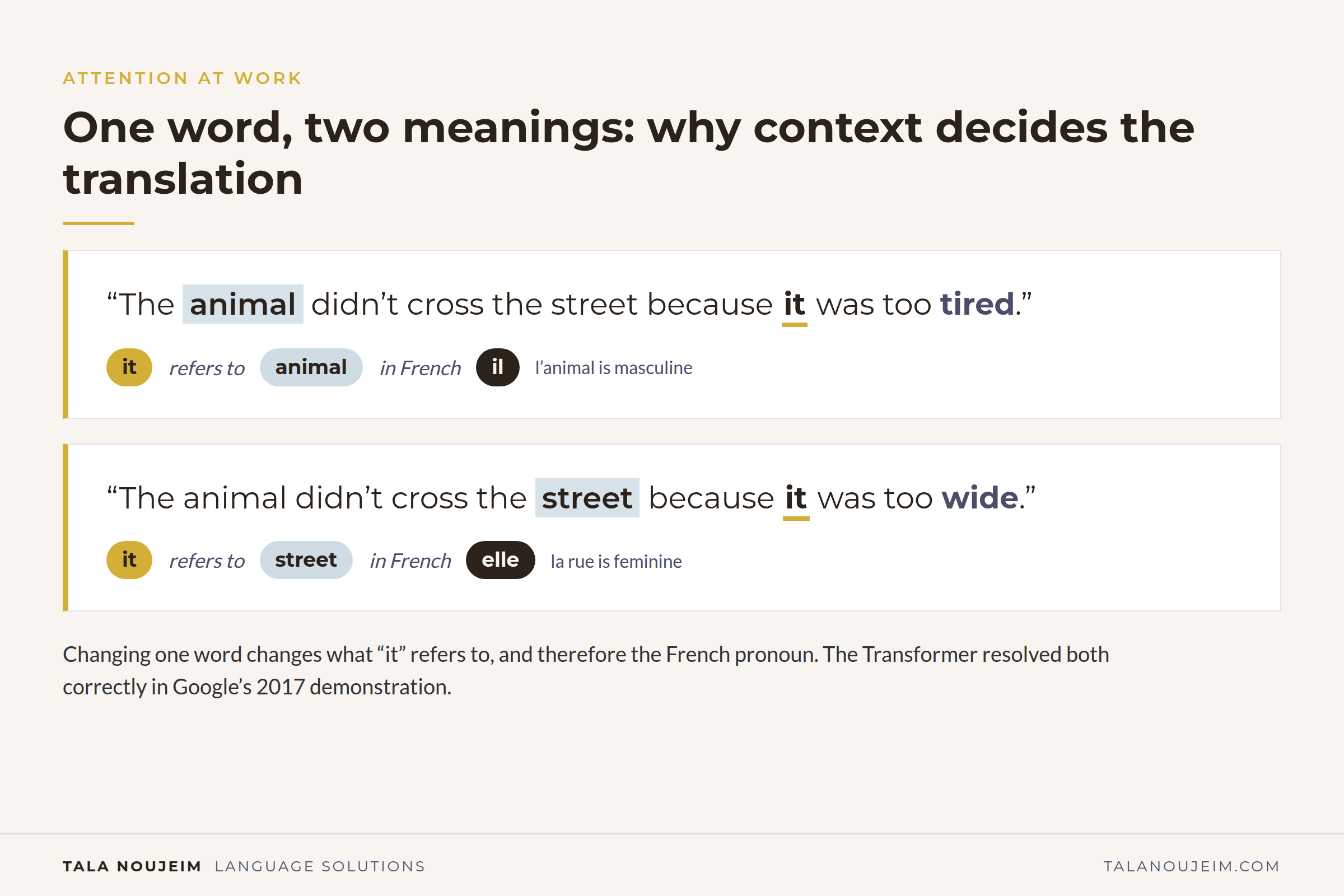
A few weeks after publication, Google illustrated the idea with an example that any translator will recognize. In the sentence "The animal didn't cross the street because it was too tired," the word "it" refers to the animal. Change "tired" to "wide," and "it" now refers to the street. In French, the correct pronoun depends on the gender of the noun being referred to, so a system that cannot resolve this reference will produce an error. The Transformer handled both versions correctly, while Google Translate's model at the time did not. This is attention at work: the model weighs every word against every other word to decide what matters for meaning.
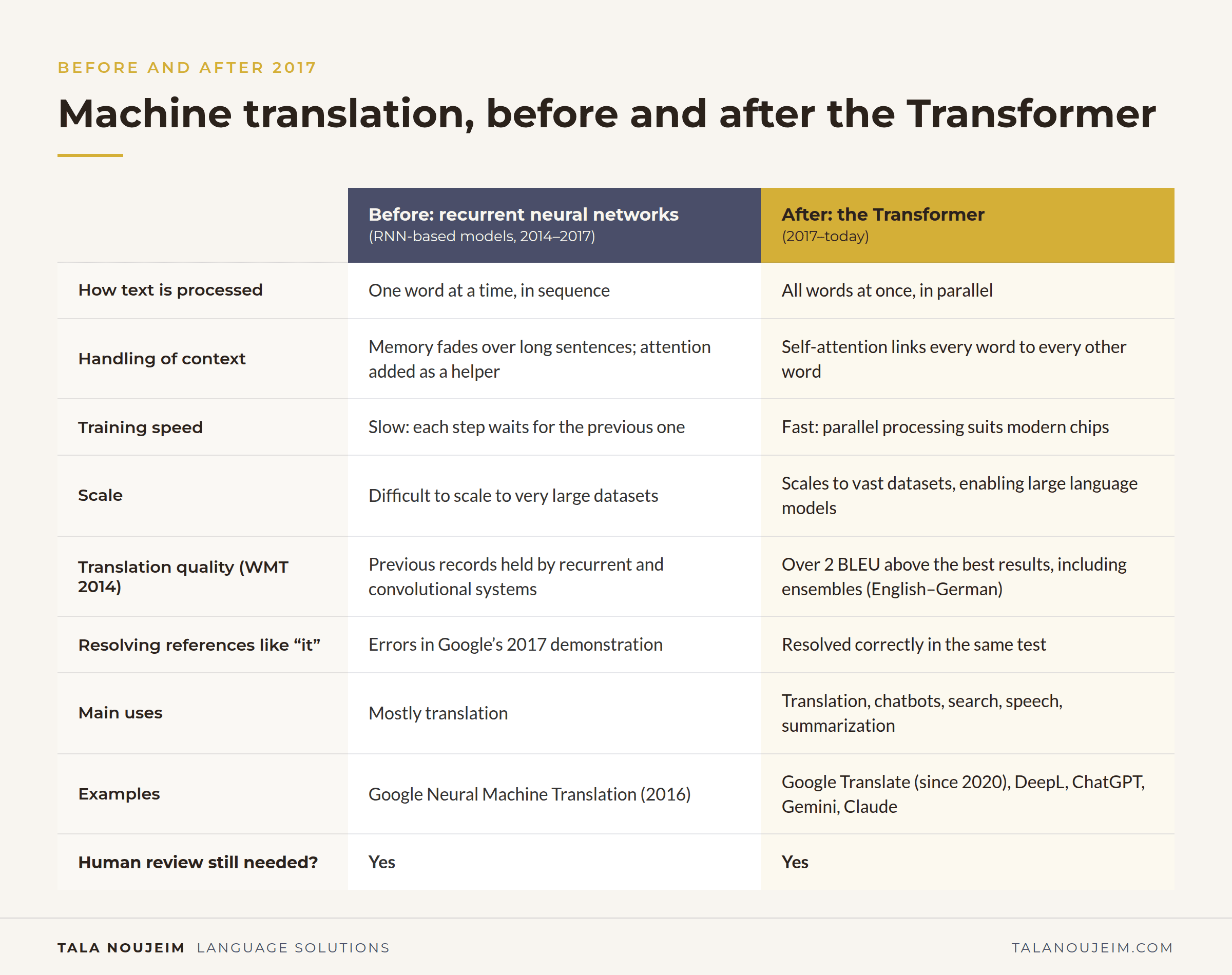
⚖️ Before and After the Transformer
The table below summarizes how the Transformer changed machine translation, compared with the recurrent neural network (RNN) models that dominated the field between 2014 and 2017.
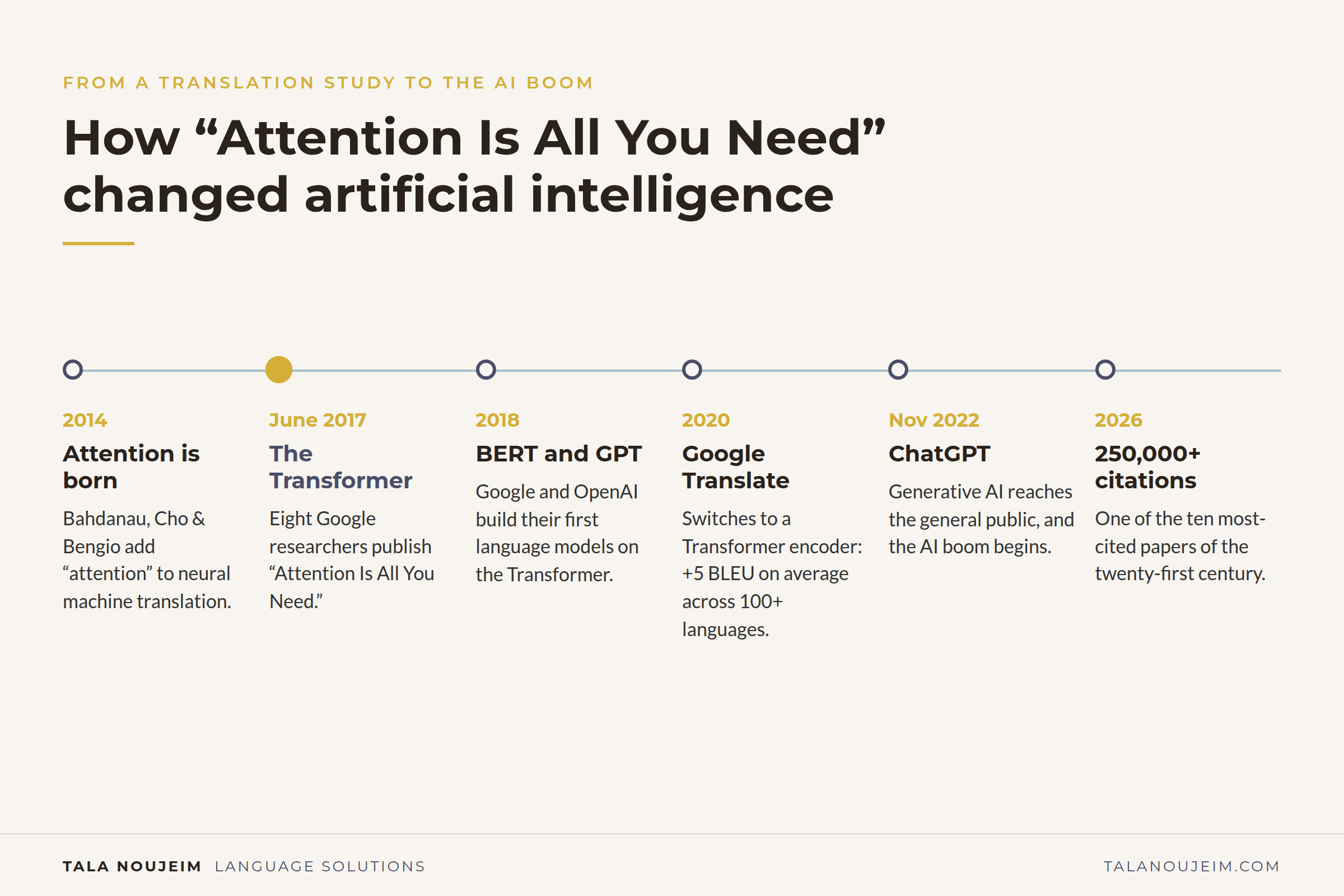
🚀 From Translation Engine to Global AI Boom
The Transformer's real breakthrough was not only quality, but scale. Because it processes all words in parallel rather than in sequence, it can be trained efficiently on enormous volumes of text using modern computer chips. This property opened the door to the large language models that followed:
2018: Google released BERT, a Transformer-based model that later improved Google Search, and OpenAI released the first GPT model. The "T" in GPT, and in ChatGPT, stands for "Transformer."
2020: Google Translate replaced its previous system with a Transformer-based encoder, reporting an average gain of five BLEU points across more than 100 languages, and around seven points for low-resource languages.
2022: ChatGPT launched in November and brought generative AI to the general public, triggering the boom we are living through today.
The paper also reshaped the industry itself. By mid-2026, all eight authors had left Google to found or join other ventures, including Cohere, Essential AI, Sakana AI, Inceptive, NEAR and OpenAI. A study written to improve translation quality became the foundation of an entire technology sector.
⚖️ What "Attention Is All You Need" Means for Translators and Interpreters
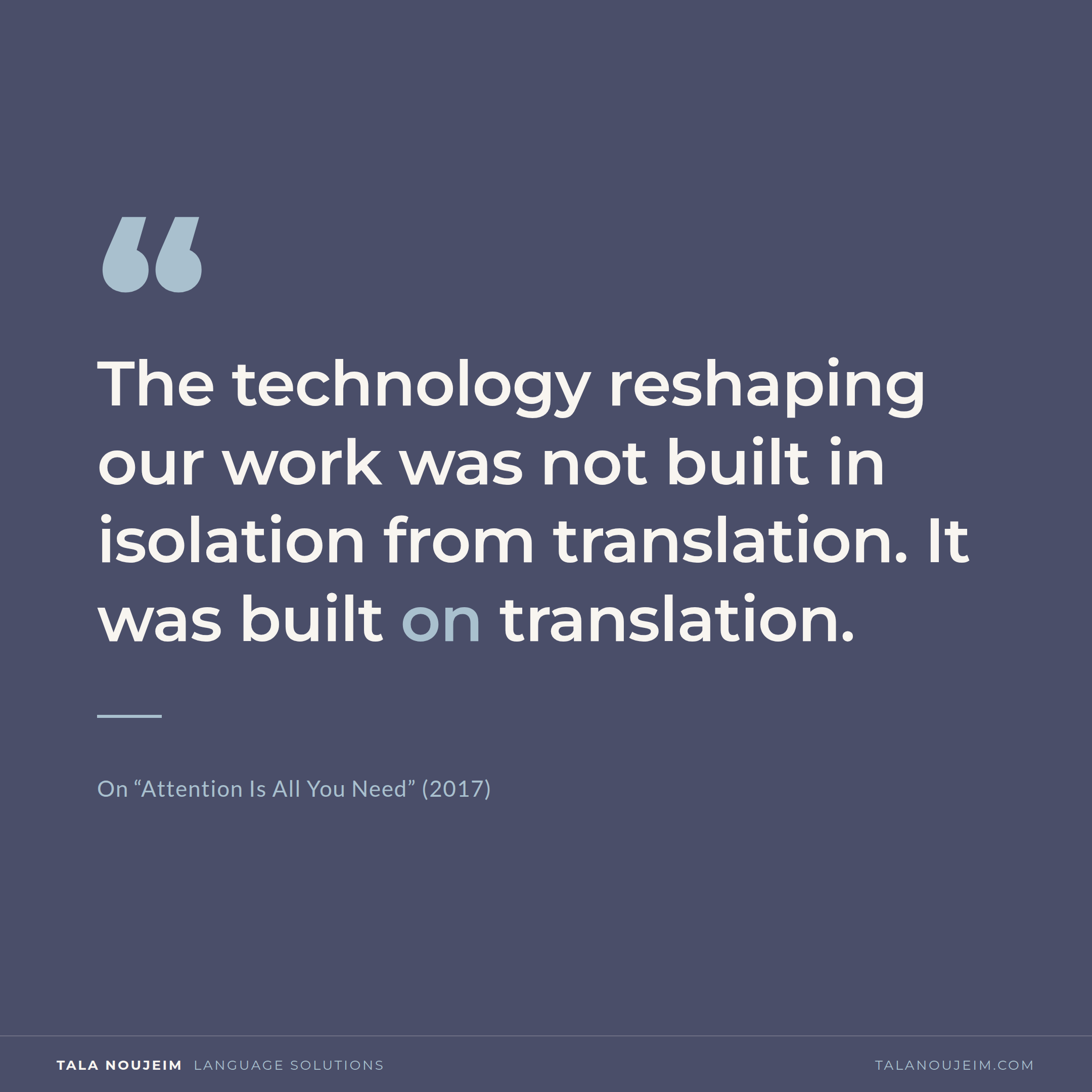
For language professionals, this history carries a meaningful lesson. The technology now reshaping our work was not built in isolation from translation; it was built on translation. Machine translation served as the proving ground for the Transformer because translation is one of the hardest tests of language understanding: it demands context, reference, grammar and meaning all at once.
The same architecture now powers the neural machine translation engines, AI writing assistants and speech recognition tools that many of us use daily, including in remote interpretation settings. Understanding where these tools come from helps us use them wisely.
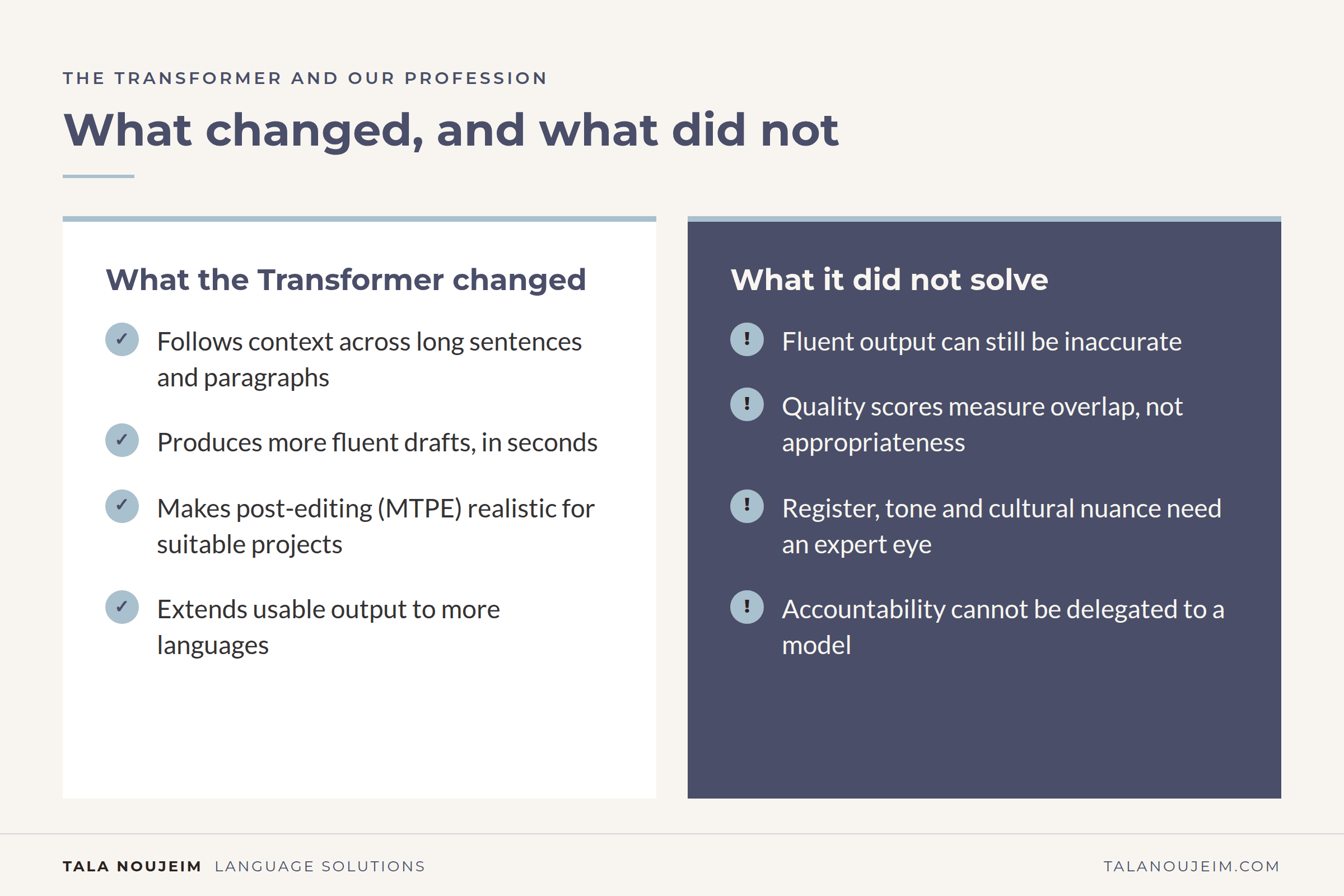
✅ What the Transformer Changed
✅ Context: AI translation can now follow references across long sentences and paragraphs far better than earlier systems.
✅ Fluency and speed: first drafts read more naturally and arrive in seconds, which makes machine translation post-editing (MTPE) a realistic workflow for suitable projects.
✅ Language coverage: more languages, including lower-resource ones, now benefit from usable machine output.
⚠️ What It Did Not Solve
Attention is a statistical mechanism, not comprehension. A Transformer weighs relationships between words; it does not understand the political sensitivity of a statement, the protocol of a diplomatic exchange or the cultural weight of a single term. As we explored in AI Translation: Threat or Opportunity?, several limitations remain:
Fluent output can still be inaccurate, and fluency makes errors harder to spot.
BLEU and similar scores measure overlap with a reference text, not whether a message is appropriate for its audience.
Register, tone and cultural nuance, especially across Arabic, French and English, still require an expert human eye.
Accountability cannot be delegated to a model. When a document or a live exchange carries legal, reputational or humanitarian stakes, a qualified professional must stand behind the result.
❓ Frequently Asked Questions About "Attention Is All You Need"
Who wrote "Attention Is All You Need"?
The paper was written by eight researchers at Google: Ashish Vaswani, Noam Shazeer, Niki Parmar, Jakob Uszkoreit, Llion Jones, Aidan N. Gomez, Łukasz Kaiser and Illia Polosukhin. It was posted online in June 2017 and presented at the NeurIPS conference in December 2017.
What is a Transformer in AI?
A Transformer is a type of neural network that processes all the words in a text at the same time and uses "attention" to decide which words are most relevant to one another. It is the architecture behind most modern language models, including ChatGPT.
Was the Transformer originally designed for translation?
Yes. The paper tested the Transformer on English-to-German and English-to-French machine translation, where it set new records. Its authors anticipated wider uses, which later materialized in chatbots, search, speech recognition and many other applications.
Does AI translation make professional translators unnecessary?
No. The Transformer made machine output faster and more fluent, but it did not give machines accountability, cultural judgment or an understanding of stakes. Professional review remains essential for any content where accuracy and tone matter.
🔑 The Bottom Line
"Attention Is All You Need" is one of the most influential scientific papers of our time, and it began as an effort to translate better. That origin is a reminder that language is not a side topic in artificial intelligence; it is at its very core. For translators and interpreters, the right response is neither fear nor blind enthusiasm, but informed, deliberate use: letting AI handle speed and consistency, while human expertise safeguards meaning, nuance and trust.
On this International Translation Day, I would like to share a more personal reflection.
Listening to the speakers at the ETIB roundtable, I was struck by how determined our profession is to defend itself. Language professionals, and institutions that have trained translators and interpreters for generations, are doing everything they can to protect this work.
And yet, more and more, I find myself thinking of the Titanic. AI is evolving at remarkable speed and with growing independence, and I cannot rule out that, in the near future, many language professionals will no longer be needed.
Centuries after Saint Jerome translated most of the Bible into Latin and became our patron saint, and eighty years after the Nuremberg Trials gave birth to modern simultaneous interpretation, I ask myself: will this profession stand the test of time, even if its value remains? Will organizations still be willing to pay for a good translation, or will they keep cutting budgets and use whatever is at hand?
Everything already moves faster than it used to. There is less time to review, fewer projects reach professionals, and quality is slipping. Perhaps this will become the new normal, and I will not pretend that does not worry me.
But I keep returning to one thing this article has shown: machines have learned to produce language, not to answer for it. As long as a mistranslated statement can cost an organization its credibility, its funding or its safety, someone will need to stand behind every word. The question is not whether the profession survives, but whether clients will recognize the moments when that person matters. On this International Translation Day, that is the conversation I would like us to have.
If your next project is one of those moments, get in touch.
At Tala Noujeim Language Solutions, we combine human expertise with the latest AI translation technology to deliver quality, efficiency, and peace of mind — for every project, in every language.
References
Bahdanau, D., Cho, K., & Bengio, Y. (2014). Neural machine translation by jointly learning to align and translate. arXiv:1409.0473.
Caswell, I., & Liang, B. (2020). Recent advances in Google Translate. Google Research Blog.
CNBC. (2026, June 18). Google Gemini co-lead Noam Shazeer leaves for OpenAI. CNBC.
Devlin, J., Chang, M.-W., Lee, K., & Toutanova, K. (2018). BERT: Pre-training of deep bidirectional transformers for language understanding. arXiv:1810.04805.
Nature. (2025). The most-cited papers of the twenty-first century. Nature.
Radford, A., Narasimhan, K., Salimans, T., & Sutskever, I. (2018). Improving language understanding by generative pre-training. OpenAI.
The National WWII Museum. Translating and interpreting the Nuremberg Trials. The National WWII Museum.
United Nations. (2017). International Translation Day (General Assembly resolution 71/288). United Nations.
Uszkoreit, J. (2017). Transformer: A novel neural network architecture for language understanding. Google Research Blog.
Vaswani, A., Shazeer, N., Parmar, N., Uszkoreit, J., Jones, L., Gomez, A. N., Kaiser, Ł., & Polosukhin, I. (2017). Attention is all you need. Advances in Neural Information Processing Systems 30 (NeurIPS 2017). arXiv:1706.03762.
Wikipedia. (2026). Attention Is All You Need. Wikipedia, The Free Encyclopedia.
